
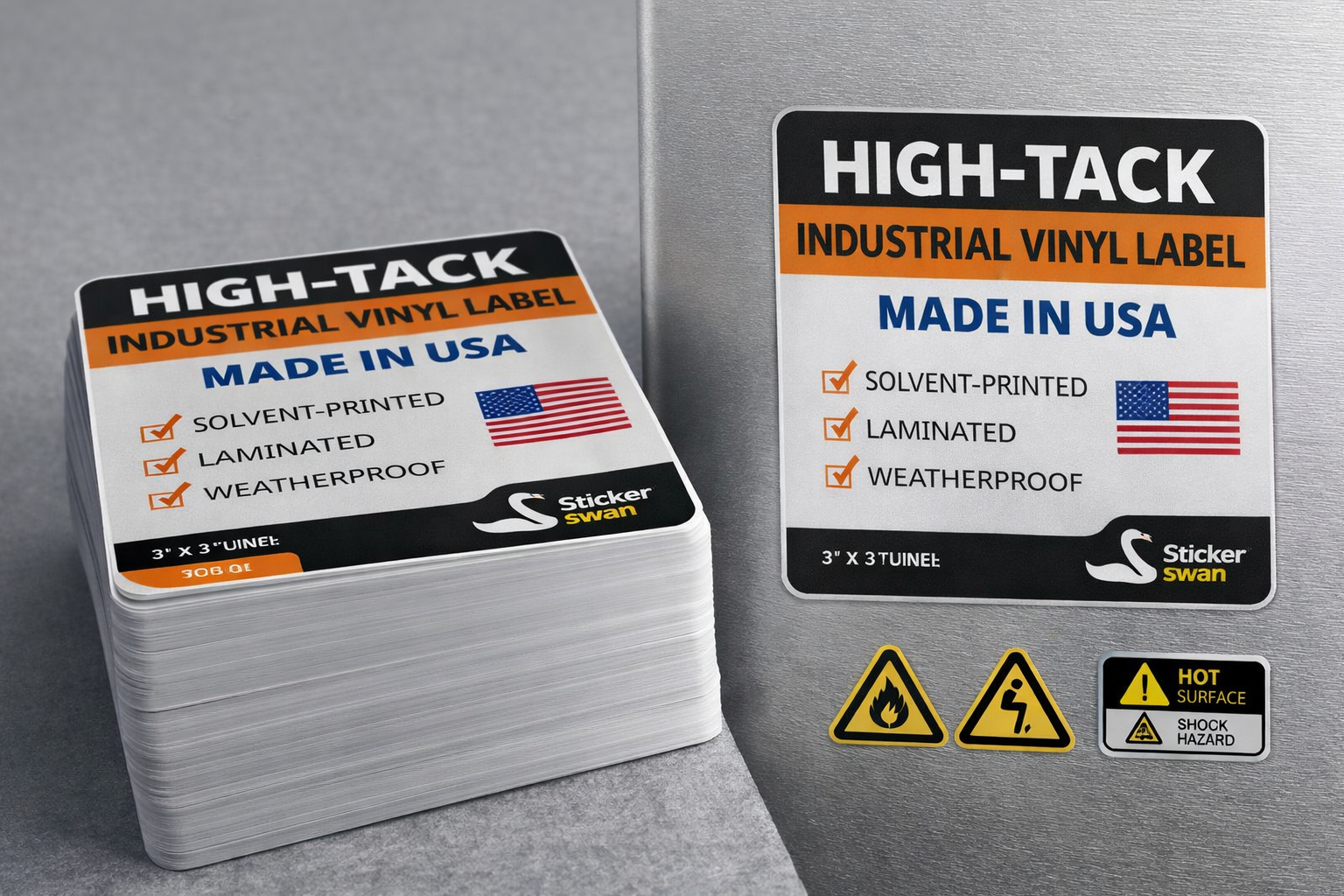
Industrial vinyl labels for plumbers, electricians and HVAC contractors
When a label identifies equipment, a shutoff, a circuit or the next service date, adhesion and readability matter more than marketing adjectives. Sticker Swan produces laminated high-tack labels for demanding rigid surfaces—with custom sizing, free standard U.S. shipping and clear guidance on where testing is required.
What labels should plumbers, electricians and HVAC contractors use?
Use laminated high-tack vinyl labels when the application involves rigid equipment, coated metal, plastic housings, bins, tools or lightly textured surfaces where standard permanent stickers may lift. Choose the label size and finish for readability, clean the surface, apply at 32°F or warmer, use firm pressure and allow at least 24 hours before washing or severe exposure.
Because paints, plastics, powder coatings and textures vary, test the actual surface first whenever failure could affect safety, compliance, warranty coverage or equipment operation.
Practical label uses for each trade
The strongest contractor label is specific: it tells the next technician what the equipment is, what action to take or where to find the service record.
Plumbing labels
Identify systems and leave useful service information where future technicians can find it.
- Shutoff and flow-direction markers
- Water-heater service labels
- Pump and valve identification
- Installation date and company contact
- QR links to maintenance instructions
Electrical labels
Keep purpose, ratings and service information legible on panels and equipment housings.
- Panel and disconnect identification
- Circuit and breaker schedules
- Voltage and equipment markings
- Warning and instruction graphics
- Asset IDs, barcodes and QR codes
HVAC labels
Support installation, recurring maintenance and equipment identification in one durable format.
- Filter size and replacement intervals
- Unit and zone identification
- Service-date and inspection labels
- Startup and shutdown instructions
- Installer branding and contact details
What makes Sticker Swan’s high-tack label different?
It combines aggressive permanent adhesion, full-color printing and a protective gloss or matte laminate. The complete tested material system is proprietary.
| Decision point | Standard permanent sticker | High-tack industrial label |
|---|---|---|
| Best use | Smooth, clean, easy-to-bond surfaces | Difficult rigid surfaces needing stronger initial grab |
| Typical surfaces | Glass, smooth finished metal, many smooth plastics | Equipment housings, bins, coated metal and selected low-surface-energy plastics |
| Protection | Depends on the selected sticker product | Gloss or matte protective laminate |
| Surface testing | Recommended for unusual applications | Strongly recommended before critical or high-volume use |
| Starting offer | Varies by product | 100 labels from $109 |
High-tack label specifications
These figures describe the current Sticker Swan high-tack construction. They are not universal guarantees for every surface or environment.
Important: Actual service life varies with the surface, preparation, exposure direction, cleaning methods, chemicals, abrasion, print coverage and environmental conditions. Horizontal exposure, power washing, sharp curves and severe chemical contact may shorten performance.
Will high-tack labels stick to your equipment?
Adhesive performance is a relationship between the label and the substrate. Use this as a selection guide, then test the exact surface.
| Surface or condition | Guidance | What to do |
|---|---|---|
| Clean painted or powder-coated metal | Good candidate | Confirm the coating is fully cured; clean and test. |
| Smooth rigid equipment housings | Good candidate | Remove oil, dust and cleaning residue before application. |
| Polyethylene or polypropylene | Always test | Formulations vary, even between similar-looking bins and cases. |
| Lightly textured rigid surfaces | Test contact area | Texture reduces adhesive contact; use firm, even pressure. |
| Tight curves or small cylinders | Test edge lift | Curvature creates return force that can lift label edges. |
| Dust, oil, wax or silicone residue | Do not apply as-is | Clean completely with a surface-safe method and allow it to dry. |
| Flexible rubber or silicone | Do not assume compatibility | Contact Sticker Swan and test before ordering a full run. |
| Deep texture or unstable paint | High failure risk | Correct the substrate or use a different identification method. |
How to order industrial labels without expensive rework
Start with the application—not the artwork. This five-step workflow catches the issues that usually cause label failure.
Record the material, coating, texture, curve and normal contamination.
Select size, quantity and gloss or matte based on visibility and glare.
Use a transparent PNG at 300 PPI final size, SVG or another supported high-resolution file.
Apply a sample to the actual equipment and evaluate edge lift and readability.
Clean, dry, apply at 32°F or warmer, press firmly and allow 24 hours before severe exposure.
IronClad™ test pack
Test adhesion and readability on tools, machinery, bins, equipment cases or coated metal before committing to a production quantity.
- Made for surface evaluation
- Matte or gloss laminate options
- Free standard U.S. shipping
High-tack industrial labels
For proven artwork and tested surfaces. Select one of five standard sizes, four online quantities and a gloss or matte finish.
- High-tack permanent adhesive
- Protective laminate
- Free standard U.S. shipping
Most print-ready high-tack orders are produced in 2–4 business days after payment and usable artwork are received. Carrier transit begins after production. Choose UPS 2nd Day Air or Next Day Air for firm deadlines.
A durable label is not automatically a compliant label
Sticker Swan prints customer-supplied identification, warning and instruction artwork. Purchasing a label does not by itself make the design OSHA-, ANSI-, NFPA-, UL-, CSA- or industry compliant.
For example, OSHA requires certain electrical equipment markings to be durable enough for the environment, and Hazard Communication labels can require specific product identifiers, signal words, hazard statements, pictograms and precautionary statements. The required content depends on the application.
The purchaser remains responsible for wording, symbols, colors, size, placement, legibility, testing, documentation and approvals. Review the applicable rules or work with a qualified safety professional before ordering regulated labels.
Official references: OSHA electrical equipment markings and OSHA Hazard Communication label elements.
Industrial vinyl label FAQs
What are high-tack industrial vinyl labels?
They are laminated vinyl labels with aggressive permanent adhesion designed for difficult rigid surfaces such as equipment housings, bins, coated metal and selected plastics where standard stickers may lift.
Are these labels suitable for plumbers?
Yes, they can be used for shutoff identification, flow direction, service dates, equipment branding and maintenance instructions. Test any surface exposed to persistent moisture, chemicals or severe cleaning.
Can electricians use them on panels and equipment?
They can be printed for panel identification, disconnect purposes, ratings, instructions and warnings. The purchaser must confirm that the design, durability, placement and approval requirements meet the rules for the intended electrical application.
What HVAC information can be printed on them?
Common content includes unit IDs, zones, filter sizes, replacement intervals, service dates, installer contact information and startup or shutdown instructions.
Will high-tack labels stick to polyethylene or polypropylene?
They are designed for many difficult plastics, including certain polyethylene and polypropylene surfaces. Formulations and textures vary, so test the exact item before a critical or high-volume installation.
Are the labels waterproof and chemical resistant?
The current high-tack construction is designed to resist water, UV exposure, abrasion and normal weathering. Chemical type, concentration, dwell time and cleaning method vary, so chemical exposure should be tested for the intended application.
How long do the labels last outdoors?
They are designed for up to five years of vertical outdoor use under normal conditions. Horizontal exposure, severe weather, chemicals, abrasion, power washing and poor surface preparation can shorten service life.
How should the surface be prepared?
Use a clean, dry surface free of dust, oil, wax, silicone and cleaning residue. Confirm that paint is fully cured, apply at 32°F or warmer, press firmly and allow at least 24 hours before washing or severe exposure.
What artwork file should I upload?
A transparent PNG at 300 pixels per inch at final size is recommended. High-resolution JPG, PDF, SVG, AI and EPS files are also supported. Keep critical text and symbols away from the cut edge.
How much do custom high-tack labels cost?
The current online production offer starts at $109 for 100 labels, with free standard U.S. shipping. Price varies by size and quantity. A 12-label IronClad sample option is available for surface testing.
Test the surface—or place the production order
If the equipment surface is new, textured, curved or made from a difficult plastic, begin with samples. If the artwork and substrate are already proven, order high-tack production labels starting at 100 pieces.
Technical sources
Product specifications and pricing were verified August 26, 2026. Live product and checkout pages control if an option changes.

Share:
Cheap Custom Stickers (Best Value Online)
Industrial Labels That Withstand Heat, Water & Chemicals