
Are Bulk Stickers Cheaper Than Print-on-Demand?
Usually—once a design has proven demand. Bulk printing lowers the production cost per sticker, but it requires upfront cash, inventory and self-fulfillment. Print-on-demand avoids unsold stock and fulfillment work, but each order carries a higher production cost.

Does Bulk Still Save Money If You Ship Only Three Stickers?
Yes on allocated production cost: if 100 stickers cost $25, each sticker costs $0.25 and three stickers use $0.75 of inventory. But $0.75 is not the complete fulfillment cost. The seller must also include postage, envelope or insert, labor, payment and marketplace fees, replacement risk and the cost of inventory that may remain unsold.
Allocated cost per fulfilled order
This view treats each sticker as consuming $0.25 of inventory. With the editable example below, three stickers plus postage, packaging and labor cost approximately $2.29 per order before marketplace, payment, tax, loss and return costs.
Actual upfront cash
The seller still pays the full $25 inventory purchase before the first order ships. If only three stickers ever sell, the business spent $25 on product—not $0.75—and still owns 97 unsold stickers.
Bulk Stickers vs. Print-on-Demand Cost Calculator
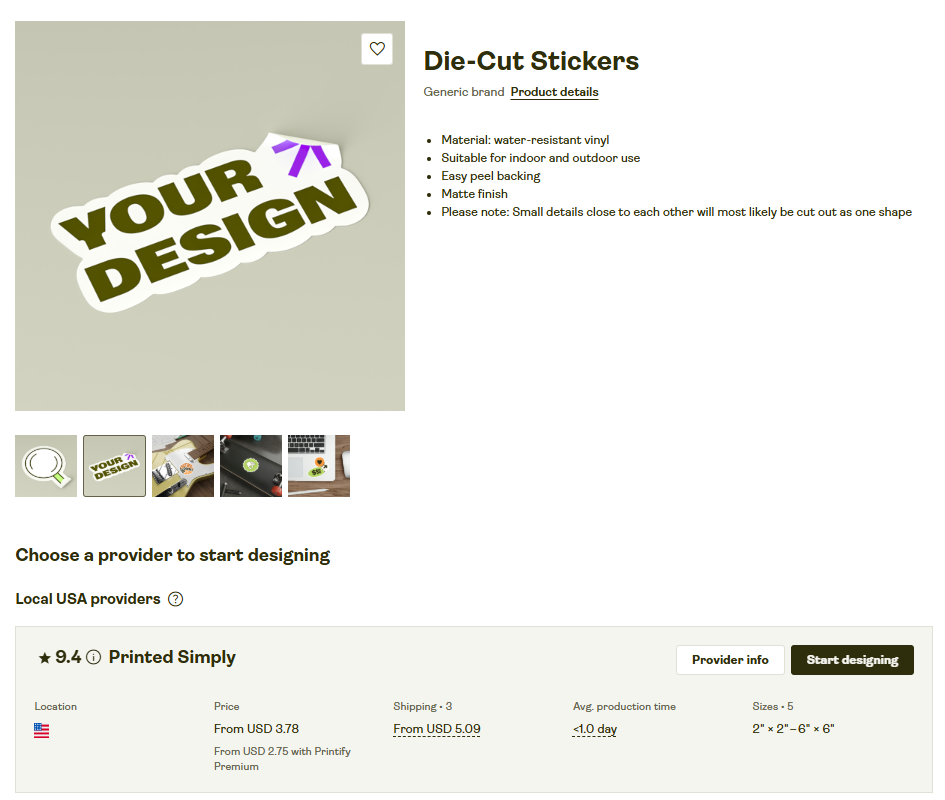
Replace every default with your actual supplier quote, postage, packaging and labor. The Printify production input uses the approximately $3.55 starting price cited in Printify’s own 3″ × 3″ example; provider, product, subscription, destination and shipping costs vary.
Enter Your Actual Costs
All values are editable. Results update automatically.
Bulk inventory
Self-fulfillment cost per customer order
Print-on-demand cost per customer order
Your Results
Can You Mail Three Stickers With a Regular Stamp?
Possibly—but only when the completed mailpiece qualifies as a First-Class Mail letter. As of August 25, 2026, USPS lists a one-ounce stamped letter at $0.82 and a one-ounce metered letter at $0.78. A letter can be up to 11½ inches long, 6⅛ inches high and ¼ inch thick, but dimensions alone do not guarantee machinability.
| Check | Current USPS standard | Seller action |
|---|---|---|
| Retail postage | 1 oz stamped letter: $0.82; metered letter: $0.78 | Use the current price, not the old $0.74 figure |
| Letter dimensions | 5–11½″ long, 3½–6⅛″ high, 0.007–¼″ thick | Measure the sealed envelope at its thickest point |
| Weight | Letter rates increase by ounce; letter-size maximum is 3.5 oz | Weigh the completed envelope, not only the stickers |
| Machinability | Rigidity, uneven thickness, clasps and other characteristics can trigger a surcharge | Distribute contents evenly and test the exact mailpiece |
| Tracking | First-Class Mail letters and flats do not include USPS Tracking | Price the risk or use a tracked parcel service when needed |
When Does Bulk Printing Beat Print-on-Demand?
Bulk is usually stronger when:
- The design already sells consistently.
- You can store and fulfill inventory reliably.
- You sell packs or include stickers with another product.
- Fast same-day seller fulfillment matters.
- Material and color consistency across orders matters.
- The projected savings justify labor and inventory risk.
POD is usually stronger when:
- The design is untested or demand is unpredictable.
- You have many designs with very few orders each.
- You cannot pack or ship customer orders.
- A supplier’s geography reduces international complexity.
- A higher unit cost is acceptable in exchange for no inventory.
- You are validating a concept before committing cash.
| Cost or risk | Bulk inventory | Print-on-demand |
|---|---|---|
| Production cost per unit | Usually decreases with quantity | Usually higher because units are produced per order |
| Upfront cash | Required before sales | Generally paid when an order is produced |
| Unsold inventory | Seller bears the risk | Little or no finished-goods inventory risk |
| Fulfillment labor | Seller or warehouse performs it | Provider performs most physical fulfillment |
| Packaging control | High | Depends on provider options |
| Quality consistency | One approved batch can improve consistency | Depends on provider, product and repeat-production conditions |
| Customer shipping | Seller selects and pays for the service | Provider rates and services apply |
The Best Model May Be Hybrid
A seller does not need to choose one fulfillment method forever. Use lower-commitment production to test demand, then move proven designs into bulk inventory when the calculator shows that the expected savings justify the commitment.
-
1
Test demand
Launch a small quantity or POD listing and track real paid orders by design.
-
2
Record true costs
Include production, shipping, labor, fees, remakes and customer-service time.
-
3
Move winners to bulk
Order inventory only for designs with enough demand to justify the upfront cash.
-
4
Retest periodically
Update postage, provider pricing, sell-through and labor assumptions as they change.
Bulk Stickers vs. Print-on-Demand FAQs
Is it cheaper to order stickers in bulk or use print-on-demand?
Bulk is usually cheaper per sticker because production costs are spread across more units. Print-on-demand can be cheaper in total cash for an unproven design if bulk inventory would remain unsold. Compare total production, fulfillment and inventory costs.
Does bulk still save money when I ship only three stickers?
With a $25 order of 100 stickers, three stickers allocate $0.75 of product cost. Add postage, packaging, labor, fees and loss risk. Bulk saves money only after enough orders recover the upfront inventory purchase.
How do I calculate the break-even point?
Compare the upfront bulk purchase with the per-order difference between POD cost and bulk self-fulfillment cost. The calculator on this page estimates the first order count where the initial bulk batch has used less cash than POD under the entered assumptions.
How much is a one-ounce USPS letter in 2026?
As of August 25, 2026, USPS lists a one-ounce stamped First-Class Mail letter at $0.82 and a metered letter at $0.78. Verify current pricing before publishing shipping rates because postage changes.
Can I mail stickers with one regular stamp?
Only if the completed envelope qualifies for the applicable First-Class Mail letter price. Weight, dimensions, rigidity, thickness and uniformity matter. Test and measure the sealed mailpiece; a nonmachinable surcharge or parcel rate may apply.
Does First-Class Mail letter service include tracking?
No. USPS states that First-Class Mail postcards, letters and flats do not include USPS Tracking. Sellers who need tracking should compare an eligible tracked service and enter that cost into the calculator.
How many stickers fit in a letter envelope?
There is no universal number. Sticker size, backing thickness, envelope, insert, weight and rigidity determine eligibility. Three thin stickers may fit, but the completed mailpiece must still satisfy current USPS standards.
When is print-on-demand better?
POD is useful for testing new designs, offering a large catalog with low sales per design, avoiding inventory, and outsourcing physical fulfillment. The tradeoff is usually a higher production cost per sold unit.
Are bulk stickers always the same quality as POD stickers?
No. Quality depends on the actual material, adhesive, ink, laminate, equipment, provider and production controls. Compare matched samples and specifications instead of assuming either model is automatically better.
What is the safest way to switch from POD to bulk?
Track sales by design, calculate true cost per order, move only proven designs into an initial bulk quantity and monitor sell-through. Keep uncertain designs on POD or a smaller test run until demand becomes clearer.
Move Proven Sticker Designs Into Better Margins
Start with a manageable quantity, enter your real fulfillment costs and increase inventory only when demand supports it.
Last reviewed: August 25, 2026. Postage, supplier prices and platform fees change. This article is an educational cost model, not a guarantee of profit, mail eligibility or delivery performance.
Official sources: USPS Notice 123 pricing, USPS physical standards for letters, USPS First-Class Mail tracking guidance, Printify’s sticker cost example and Sticker Swan’s current 100-sticker bundle.
Share:
Cheap Custom Stickers (And How to Avoid Clickbait Pricing)
Best Sticker Printing Companies (2026)